
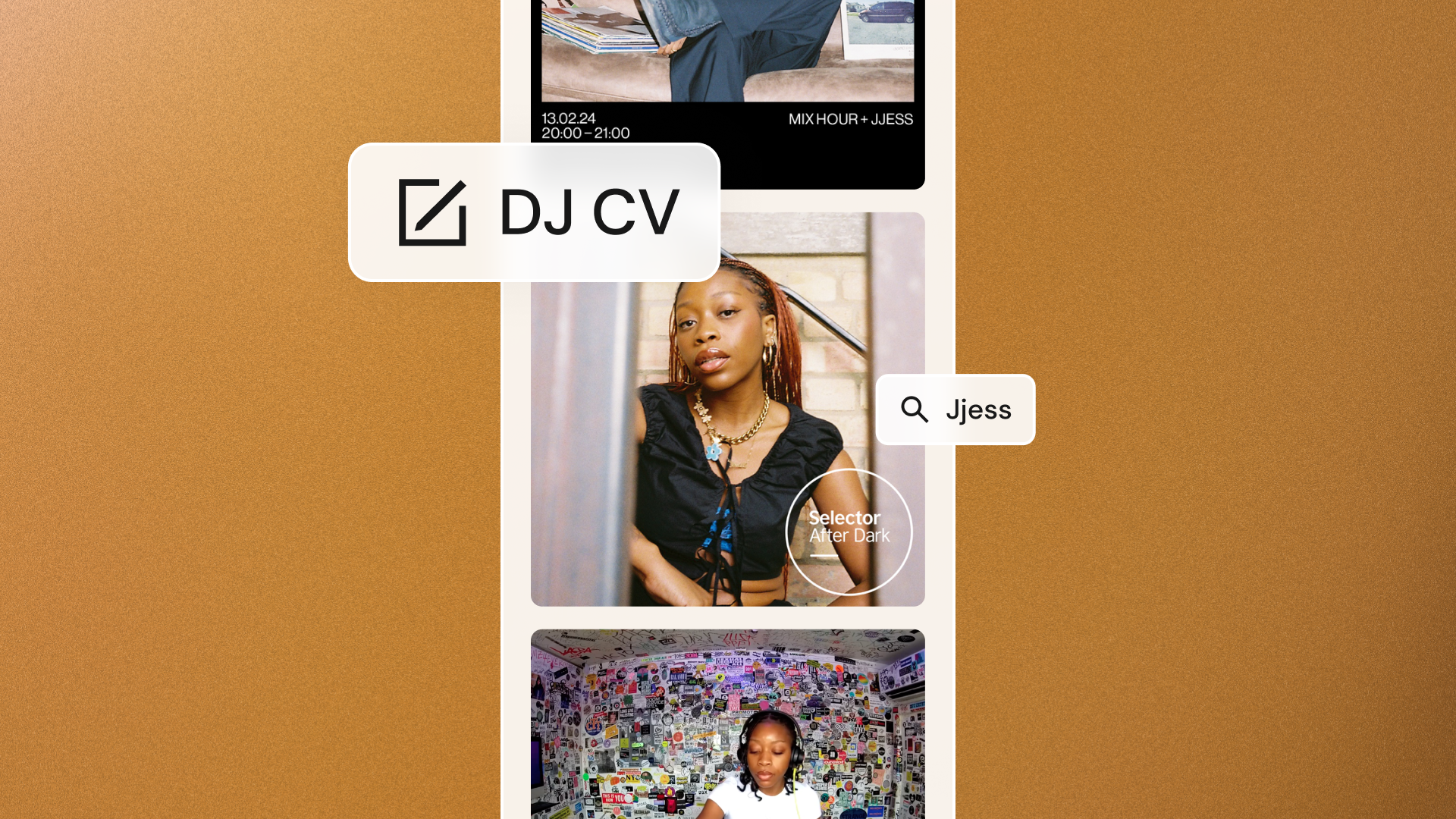
A DJ CV isn’t a corporate résumé. Treating it like one is one of the fastest ways to get ignored. Most DJs either don’t have a DJ CV at all, or they build one like a job application: long, chronological and keen to prove how busy they’ve been. That’s not what promoters, bookers, radio producers or festivals are looking for.
A good DJ CV is a curated document. It’s designed to communicate taste, credibility and trajectory quickly. It helps the right people understand who you are as a DJ, how you operate, and whether you belong in their world.
In this article, we’ll break down exactly what a DJ CV is, when you actually need one and how to curate it properly so it works the best for you.
What is a DJ CV?
A DJ CV is a short, structured overview of your work as a DJ. Unlike a traditional CV, a DJ CV doesn’t need to be chronological and it should never be exhaustive. Its entire purpose is to make a fast, confident case for why you make sense in a specific context.
If someone opens your CV, they should understand who you are in under 30 seconds.
Think about it the same way you think about a DJ set:
- You don’t play every record you own
- You don’t explain every transition
- You select what fits the room
Your DJ CV should be curated with the same discipline.
When do you actually need a DJ CV?
Not every booking requires a CV, but there are plenty of situations where having one ready makes you look organised and professional.
You’re most likely to need a DJ CV when:
- Applying for a radio show or residency
- Submitting for festivals or curated line-ups
- Applying for arts funding, grants or cultural programmes
- Pitching yourself to promoters, venues or institutions
- Responding to opportunities that ask for ‘experience’ or ‘background’ in a certain field
In these situations, a DJ CV isn’t overkill. It’s useful context.
What to include in a DJ CV
A strong DJ CV is usually one page. Two at most, if you feel your work genuinely justifies it. Essential sections for a strong CV include:
- Artist name / DJ name: Use the name you’re known by publicly.
- Short DJ bio: A concise, 2-3 line description of your sound, approach and context.
- Genres and approach: Avoid listing every genre you’ve ever played. Focus on how you play and what connects your selections.
- Selected highlights: Key moments that signal credibility: notable bookings, platforms or projects.
- Radio shows and residencies: Ongoing or recurring work carries more weight than one-off gigs.
- Notable venues, festivals or platforms: Prioritise recognisable or culturally relevant spaces.
- Mixes or recordings: Links to your profiles on platforms like Mixcloud, NTS, Rinse or similar. Make sure the links to your profiles work.
- Press or quotes (if relevant): Only include this if it genuinely adds value.
- Contact and booking information: Clear and easy to find.
- Photos: These can be of you in your DJing element, to allow employers to get a good look at you in action.
Tailoring your DJ CV for different contexts
If you send the same DJ CV to everyone, you’re doing it wrong. One CV rarely fits every situation perfectly. You should have one master CV, then lightly adapt it depending on where you’re applying.
For example:
- A club-focused CV might lead with venues, promoters and peak-time sets
- A radio application might prioritise broadcasts, archives and curatorial intent
- A funding application might foreground community work, education or long-term projects
Often, this is just a matter of reordering sections, not rewriting everything.
Treat your DJ CV like a set, not a spreadsheet
Curating a DJ CV uses the same skills you use behind the decks: selection, context, and intention. It’s about clearly showing who you are as a DJ, where you sit culturally and why your work matters. Get that right, and your CV stops being a formality. It becomes a tool for your growth as a DJ.