
For thousands of people living in prison across England and Wales, radio is more than background noise. It’s a companion in isolation, a source of vital information, a bridge to loved ones on the outside and, for many, a tool for survival. National Prison Radio broadcasts 24 hours a day into prison cells across England and Wales, reaching an audience that is often cut off from the internet, mobile phones and even basic information. Built by people who understand prison from the inside out, the station blends music, conversation, practical guidance and deeply human storytelling to support people in prison through their sentences and beyond.
At its heart, National Prison Radio, which is run by the Prison Radio Association, is about connection. To family, to opportunity and to hope. In its mission it has brought along partners such as the BBC and the Booker Prize Foundation, as well as the likes of Louis Theroux as guests. For its efforts, National Prison Radio has won several awards and the love of individuals beyond its confines.
We spoke to the Prison Radio Association’s Chief Executive, Andrew Wilkie, and Assistant Producer and host, Faye Dunn, about how National Prison Radio began, how it operates today and why radio remains such a powerful force inside prison walls.
Contents
- 0.1 What is the origin story of National Prison Radio? It’s such a novel concept even years after the station was founded…
- 0.2 Faye, how did you get involved in National Prison Radio?
- 0.3 How many people in prison do you broadcast to throughout the UK?
- 0.4 How does National Prison Radio feed into the overall structure and mission of the Prison Radio Association?
- 0.5 How do you recruit hosts for the station? Is there a criteria that you follow?
- 0.6 When it comes to training hosts to be ready for radio and to broadcast, what does that process look like?
- 0.7 What does your programming look like?
- 0.8 What do people in prison gravitate towards the most?
- 0.9 Talk to us about your studio setup.
- 0.10 How labour-intensive is it putting these shows together?
- 0.11 What would you say are some of National Prison Radio’s landmark productions?
- 0.12 Radio clearly serves as a tool for community and survival in prison. Are there any stories from your times at National Prison Radio that really put that into perspective?
- 0.13 How does your approach apply to prisons and radio organisations around the world?
- 0.14 Does National Prison Radio dispel myths about prison or people in prison?
- 0.15 How do you maintain relationships with people in prison once they leave prison?
- 0.16 Tell us about your experience on Mixcloud and how has it factored into the journey of the station?
- 0.17 Any future plans for the station that you can share?
- 1 Share this:
What is the origin story of National Prison Radio? It’s such a novel concept even years after the station was founded…
Andrew: Prison radio in the UK actually started back in the early 1990s at Feltham Young Offender Institution in Southwest London. At the time, it was a very troubled prison, it was a very violent place with a lot of incredibly sad stories. The governor was being interviewed in the local press, and two local residents who lived close by to Feltham, who went on to help found the Prison Radio Association, came up with an idea. They thought, well if hospital radio can keep people company when they’re in hospital, when they’re away from their loved ones, couldn’t the same idea be used for the boys in Feltham? So that’s where the idea came from.
That led to the creation of Radio Feltham in 1993. It had a real impact and over time, more prison radio projects began popping up around the country. In 2006, the Prison Radio Association charity was formed to bring those projects together and give prison radio a unified voice. In 2007, I was brought in to set up a station in HMP Brixton. We started broadcasting onto the wings and within a few years, we were winning major broadcasting awards. That recognition allowed us to go to the Ministry of Justice and say, we’re really good at what we do. We’re respected by our professional colleagues, and we’re making a real difference in Brixton prison. Can we expand this service to cover all of England and Wales? Over the following years, that was what we did, and that’s what became National Prison Radio.
Faye, how did you get involved in National Prison Radio?
Faye: I served 22 months in HMP Styal, and after being in there for around six weeks, I came into contact with National Prison Radio. The radio presenters were walking around the prison grounds with a microphone, capturing some voices of the ladies living on the wings. I spoke to them about my children on the outside, on Bonfire night, something as simple as that. They asked me if I’d like to come in and have a couple of trial shifts on the radio to see how I like it. I don’t like the sound of my own voice, as most people don’t when they first start on the radio.
Anyway, I gave it a go, and there was kind of no looking back. I worked inside the studio that operates in HMP Styal for my whole sentence, so around 20 months of my sentence right up until I was released. Then I was fortunate enough to be in a position where the Prison Radio Association offered me part-time employment upon release, and then after a couple of months, I moved to full time.
The power of radio when you’re living inside of a prison is huge. When you’re on the outside, you can turn on your radio and listen to however many different radio stations you want to. But what you can’t do is turn on your radio and listen to somebody presenting a show that’s been sat exactly where you’ve sat, who’s lived and breathed the emotions of what you’re going through in prison. Who has had all the ups and downs, separated from the family, from loved ones. For me, when I was living inside HMP Styal, listening to National Prison Radio was exactly that. So to then be released with the opportunity to know that my voice is going out into somebody’s cell, and I can potentially be making a difference to that person’s minute, day, month and their sentence, really meant the world to me.
How many people in prison do you broadcast to throughout the UK?
Andrew: We broadcast to prisons across England and Wales, which is around 88,000 people. If you’re in a prison cell in England or Wales, National Prison Radio is one of the channels on your in-cell TV system. It’s an audio channel delivered through the television.
How does National Prison Radio feed into the overall structure and mission of the Prison Radio Association?
Andrew: It’s absolutely central to what we do. Our mission is to support people through their prison sentences and help them avoid coming back after release. We broadcast inspirational content, but also very practical information. Things people might otherwise struggle to access. There’s no internet in prison, no mobile phones, and even newspapers can be hard to come by. National Prison Radio becomes a crucial way to share information about education, drug and alcohol services, immigration issues, literacy support and more. So what we do is keep people in touch with the world.
Faye: Music is also vital. You don’t have Mixcloud or streaming services in prison, so music becomes a way to stay connected to home, memory and emotion. That’s where shows like the ‘Family and Friends Request Show,’ which I host, come in. They’re about connection as much as entertainment.
“Listening to someone on radio who’s lived the emotions of what you’re going through in prison is huge. You can make a real difference to their whole sentence.”
How do you recruit hosts for the station? Is there a criteria that you follow?
Faye: When you’re living in prison, you can apply for jobs like kitchens or laundry. Working for National Prison Radio quickly becomes one of the most sought-after roles. The civilian staff come into the prison, do mini-recruitment drives and offer trial shifts. You need security clearance, and not everyone takes to it, but when it clicks, it really clicks. For many people, the studio doesn’t feel like prison. You’re wearing headphones, working with professional broadcasters, learning skills, listening to music. It’s a total escape. And for some, like me, it opens doors far beyond the prison gates.
The support doesn’t stop at release either. Even if someone doesn’t end up working for us, the Prison Radio Association stays in touch. We help people find opportunities and often connects them with community radio stations on the outside.
When it comes to training hosts to be ready for radio and to broadcast, what does that process look like?
Andrew: For Brixton and Styal, we will have at least two radio professionals come in every day and co-produce all of the content with the men and women we’re working with. They will deliver training in script writing, building a music playlist, presenting skills, timekeeping, communication skills, editing. All of these really important skills that anybody working in pretty much any field can benefit from. Then we also bring in guests from the outside. Sometimes, we bring in celebrity guests to be interviewees, and it’s a really memorable day for everyone.
What does your programming look like?
Andrew: We broadcast 24/7 and the schedule is incredibly varied. We have a breakfast show every morning, ‘Porridge,’ presented by Ali, who we first met when he was serving time in Brixton. There’s ‘NPR Talk’ From Monday to Friday where we’ll interview people and share information about the world. The ‘Request Show’ is also five days a week. We play a wide range of music programming: Hip-Hop, R&B, Rock. There’s ‘20th Century Hits,’ our oldies show; our love songs show ‘The Love Bug.’ The idea is that you pick up a piece of paper and you write a letter to your loved ones on the outside while listening to the show. We’ll include letter writing tips and play love songs to kind of get you in the mood.
We’re just encouraging people to be active listeners, that’s really important. As we’re a charity, we always have to evaluate what we do and prove that we’re worth having to our partners at the prison service. One of the ways we do that is by tracking how people respond to what we broadcast. Whether that’s writing home or making contact with them with a support agency. Or just thinking more deeply about your situation and what’s happened and where you’re going. We also have book readings sponsored by the National Literacy Trust and the Booker Prize Foundation. We do all sorts of stuff!
Faye: We’ve had Mel B on, she really lifted everyone’s spirits. I had the privilege of having the likes of BBC Radio 5 Live and TalkSport come in. I did an interview with Louis Theroux a while back. It’s absolutely fantastic what goes on in those studios every day.
What do people in prison gravitate towards the most?
Andrew: Music is often the entry point because it brings comfort, joy and a sense of home. But between the music, that’s where the information lives. Prison populations are incredibly diverse; ages range from teenagers to people in their 80s and 90s, from every background imaginable. We don’t have a single demographic, so we try to create corners of the schedule for everyone.
Faye: The engagement is phenomenal. People write in every day. Not just song requests, but questions, messages and calls for support. National Prison Radio has become a support system in that way.
Talk to us about your studio setup.
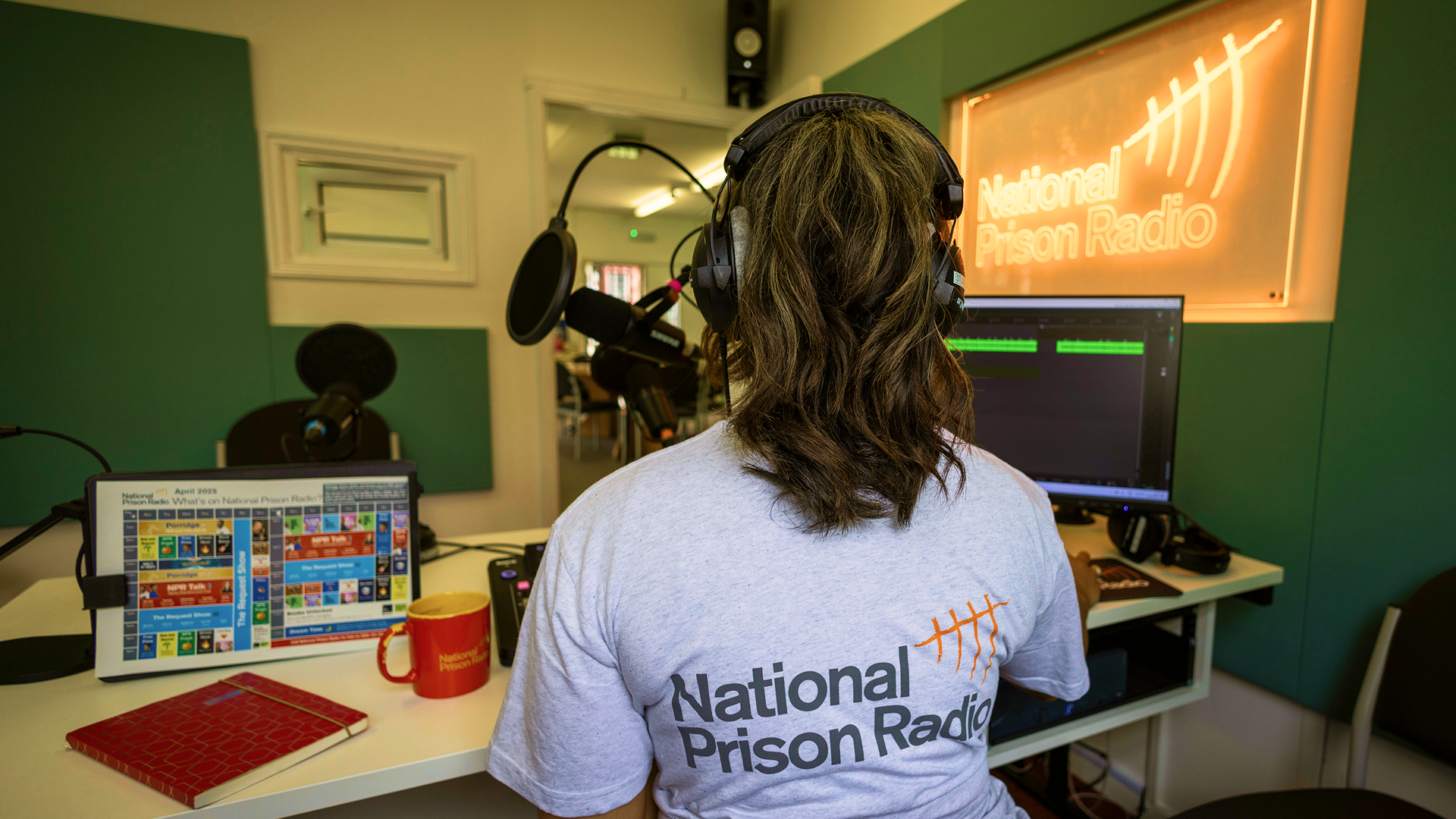
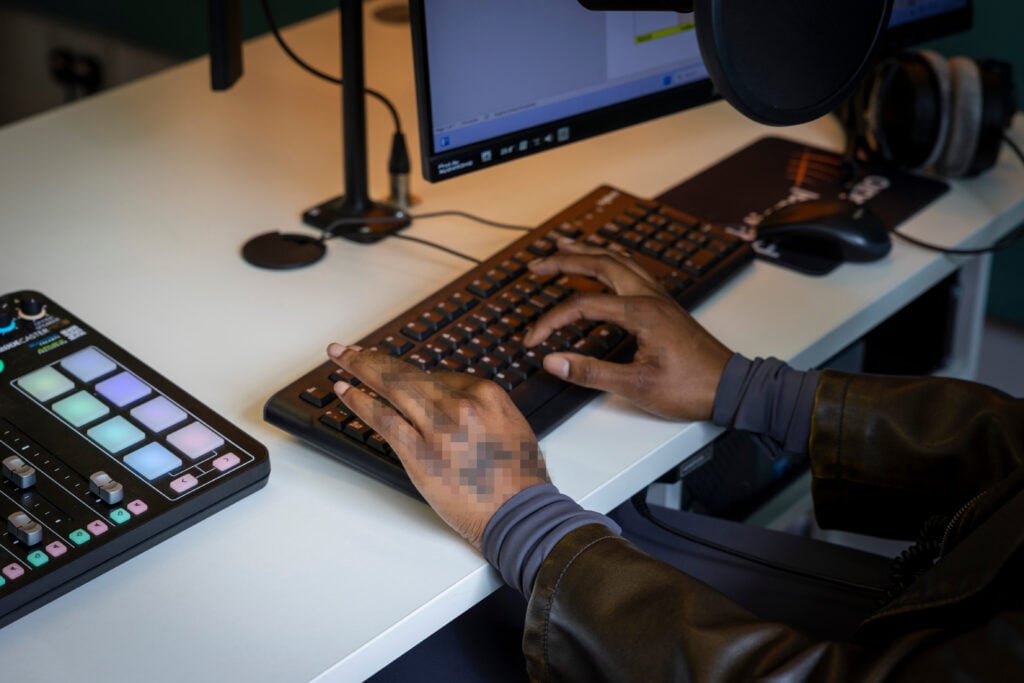
Andrew: Our studios are small and simple. We use little RODECaster desks with good quality microphones. We’ve got my pride and joy, which is the National Prison Radio logo in neon. It’s really cool! We bought it several years ago as a prop for a film we made. That’s now sitting on the wall in our studio. So, yeah, nicely branded, nice acoustic treatment on the walls. Sometimes it’s a bit noisy, but it’s kind of all part of the charm.
Faye: All that matters is the people inside the studios. You could put us in a cardboard box and know that we’re delivering audio content to people living in prison and making a difference means the world to every single person in those studios every day.
How labour-intensive is it putting these shows together?
Faye: It’s massive, especially for a charity. We’ve got a relatively small team producing 24 hours of programming every single day. But there’s so much passion behind it. Many of us have lived experience of prison, and everyone on the team brings empathy and care to the work. That’s what keeps it going.
What would you say are some of National Prison Radio’s landmark productions?
Andrew: One that really stands out was a programme we made around the first-ever half marathon run inside a British prison at HMP Brixton. People in prison trained for months thinking they’d be running on treadmills. Then on the day, a whole load of runners from the outside joined them to run laps around the prison perimeter.
We recorded it live, we had our microphones running alongside the runners! It was chaotic but it was so much fun. Prisons can feel oppressive and negative. No one wants to be in prison. Days when people smile and cheer are rare and we managed to achieve something that was incredibly special. I’ve been doing this for nearly 20 years, and that day encapsulates why I do this. When you’ve got the radio, you can create a little bit of magic. Radio is magic. You talk into a microphone and thousands of people hear what you have to say. People who you’ve never met before.
Faye: For the men living inside HMP Brixton on that day, no matter the struggles they’ve been through, no matter how hard prison life has been, they will never, ever forget that day. I know it’s a memory that will always stick with me, so I’m sure it will with them as well. So it just shows you, as Andrew said, not only do we broadcast radio, but we can go into prisons and make a difference on the ground.
Radio clearly serves as a tool for community and survival in prison. Are there any stories from your times at National Prison Radio that really put that into perspective?
Andrew: ‘Free Flow,’ hosted by Lady Unchained, is a perfect example. She went to prison, was released about 10 years ago, and not long after she got out, she made contact with us and said she wanted to work with us. Together, we developed this show called ‘Free Flow,’ which is where we play a beat twice, so you can get your bars right. We encourage our listeners to write bars which they can freestyle over voicemail on their in-cell phone. Then Lady Unchained gives feedback on their creativity and delivery.
We’ve had at least a few people who’ve been through that process, left prison and gone on to record music and get involved in the music industry. The first time anyone had heard from them was down a phone line on National Prison Radio in their prison cell. So that’s really inspirational as well. I love listening to that show.
Faye: Ask anyone inside a prison about National Prison Radio and they’ll ask, “Where’s Lady Unchained?” She is just phenomenal at what she does. And again, it’s somebody who has served time living in prison, and then she’s there to give opportunities to other people who are living in prison to make changes to their lives for the better. Ultimately, what we’re here for is to reduce reoffending and hopefully by providing those opportunities, that’s what we’re doing.
How does your approach apply to prisons and radio organisations around the world?
Andrew: We’re part of an international network called Prison Radio International. Every prison system is different, so it’s less about exporting one model and more about learning from each other. If you want to set up a prison radio project in your country, there are other projects you can use as a blueprint, and if you’re part of the collective, then it just adds a little bit of weight to your case when you’re looking, for example, for funding from your government or from charities in your country. We just want to help as many people around the world and for prison radio to exist everywhere it can because it works.
Does National Prison Radio dispel myths about prison or people in prison?
Faye: Absolutely. One of the biggest myths is that everyone in prison is bad. I’m not saying there’s not bad people in prison, but who’s to say there’s not somebody bad sitting next to you on a bus or on a train every day? It’s just a general reflection of the population. The message I try to get across every day is, just because you’re sitting in prison doesn’t mean it’s the end. You can use this as an opportunity. I always say you’ve got two choices: you either get on with it or you don’t. That might sound crass, but it’s not. You’re in a situation where you can utilize all of the opportunities that you’ve got in front of you. Life can be what you make of it.
How do you maintain relationships with people in prison once they leave prison?
Andrew: Living in prison is very different to living in the outside world but, in the cases where it works out, we will help people with job applications, identifying work placements for them and opportunities for further training. And it’s not necessarily in radio production, it could be in anything, but we will help them to get where they want to go. We’ve had several people who’ve gone on to careers in the BBC, producing music, radio programs, studio management, sound design. We will help people as much as we can.
Tell us about your experience on Mixcloud and how has it factored into the journey of the station?
Andrew: We first started using Mixcloud because we were looking for a way to share the ‘Family and Friends Request Show’ with listeners on the outside. The only place you can listen to National Prison Radio is in a prison cell, so this presented a challenge as we wanted loved-ones to feel connected to the show, and to the people they care for, using the power of music. Mixcloud was the ideal platform for us because it allowed us to include music, and also because the platform itself is so easy to use and we wanted to make it simple for people to find us. Even if they’re not particularly confident with technology or if they’re not usually into specialist music.
Sending people to Mixcloud is part of our publicity. It’s helped us to build a community of people who offer support to loved-ones in prison, and we know how valuable this is because people who maintain contact with family and loved-ones during a prison sentence are significantly less likely to return to prison after release.
Andrew: We won a host of awards for our programmes last year, including the ARIAS and the Audio Production Awards. We want to maintain that quality and keep producing programmes that help our listeners.
Follow National Prison Radio on Mixcloud, Instagram and X.
Lead photo credit: Andy Aitchison