00:00
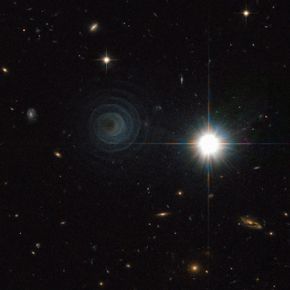
This remarkable picture from the Advanced Camera for Surveys on the NASA/ESA Hubble Space Telescope shows one of the most perfect geometrical forms created in space. It captures the formation of an unusual pre-planetary nebula, known as IRAS 23166+1655, around the star LL Pegasi (also known as AFGL 3068) in the constellation of Pegasus (the Winged Horse).
The striking picture shows what appears to be a thin spiral pattern of astonishingly regularity winding around the star, which is itself hidden behind thick dust. The spiral pattern suggests a regular periodic origin for the nebula’s shape. The material forming the spiral is moving outwards a speed of about 50 000 km/hour and, by combining this speed with the distance between layers, astronomers calculate that the shells are each separated by about 800 years.


Comments
00:00